A Hogsback Snow Week: What a Big Fall Really Looks Like
A Hogsback Snow Week: What a Big Fall Really Looks Like
Every winter the same question floods in from the lowlands: is it snowing in Hogsback? We keep the practical answer on our snow report page. This post is the other answer — what a proper fall actually does to this village, told through a century of residents who lived through them.
Because Hogsback snow is not new. It is one of the oldest stories the mountain tells.
“Sometimes nine inches or more”
Rev Joe Lister — the famous blind minister who first visited Hogsback in 1919 and knew the mountain for most of a century — set down the ground truth in his memoir Echoes from the Past: the Hogsback sits in the summer rainfall region, but the weather is unpredictable; snow and frost may occur at any time of the year, and there are generally snowfalls in winter, “sometimes nine inches or more.”
Any time of the year is not an exaggeration. Lister recorded climbing Gaika’s Kop on a November day of intense heat, being chased back to camp by a violent thunderstorm — and waking the next day to find the mountain capped with snow. That is the Hogsback recipe in one anecdote: heat, front, deluge, white morning.
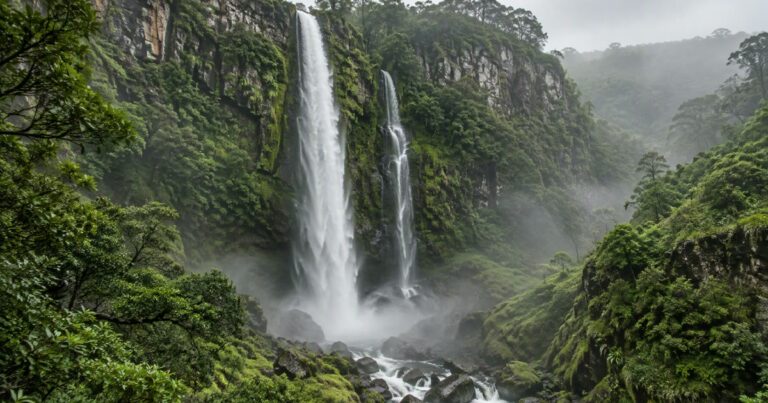
His most magical detail is about Kettlespout Falls, the waterfall that famously blows upward in a strong wind: in exceptionally cold winters, Lister wrote, it has frozen over completely, forming a bridge of ice.
The kitten and the hot-water bottle
For the domestic side of a snow week, we have MMS Ballantyne’s memoir Hogsback our Haven. In the early camping-holiday days, her family would come up for the June holidays to their thatched “Big Hut” — and one year “there was quite a heavy fall of snow, so my ginger kitten slept in an up-turned stool on a hot-water bottle.” Life was oatmeal porridge twice a day for warmth, long walks, and bracing mountain air.
When the Hendersons of Lovedale took a winter holiday cottage at Hunterstoun, the whole point was “the prospect of snow” — the exodus up the mountain went by tented wagon behind a span of eighteen oxen, loaded with furniture, library books and crates of live poultry. People have been planning Hogsback snow trips, badly overpacking for Hogsback snow trips, and loving every minute, for over a hundred years.
The week the road disappeared
The big falls close roads — then and now. Ballantyne records that in 1964, after a particularly heavy fall, the road to Cathcart was shut entirely: telephone poles were down, a snow fight broke out just beyond the crossroads, and eventually “a track was cut through walls of snow” so she could get through to fetch a visitor from the 8 a.m. train — following a neighbour armed with a spade.
And Lister gives us the strangest snow image in the village’s records: when the old sawmills burned, one fire was “spectacular against a background of snow” — a smouldering sawdust mountain glowing in a white landscape.
The lesson inside all these stories has not changed in sixty years: when Hogsback gets real snow, you do not travel through it — you are either already here, or you wait. Modern cars have not repealed mountain weather.
When to come, and how
The 1979 Holliday brochure described the pattern that still holds: gloriously sunny winter days followed by sharp cold nights, with the first heavy snowfalls expected as the season deepens. Peak season runs June to August, with falls recorded as late as October — but no year signs a contract.
The modern playbook, refined by generations of snow-chasers:
1. Watch the front, not the calendar. A deep south-westerly cold front aimed at the Eastern Cape interior is the trigger. Our snow page explains the signs residents watch for.
2. Book the moment the front is forecast. When flakes actually fall, the village books out in hours — start with accommodation, and favour fireplaces, kitchens and backup power.
3. Arrive ahead of the weather. Check getting here and travel the day before the front. The 1964 crowd needed ox-spans and spades; you’ll need patience and possibly a tow.
4. Then stay put and enjoy it. The forest in snow is the point — the pines carrying white sleeves, the village gone quiet. Walkers should keep to short, familiar routes; see the hiking guide and respect the mist warnings that have been standard here since at least 1979.
The oldest weather story on the mountain
A snow week in Hogsback connects you to every generation that came before: the kitten on the hot-water bottle, the porridge twice a day, the ice bridge over Kettlespout, the spade-wielding neighbours cutting a track to Cathcart. The equipment improves. The story doesn’t change.
Watch the forecast. Book fast. Come up early. And if you wake to a white morning — you’ll understand why families used to drag eighteen oxen up a mountain for the chance.
—
Sources: Rev JS Lister, “Echoes from the Past”; MMS Ballantyne, “Hogsback our Haven”; the 1979 E.W. Holliday brochure; current resident reporting via this site.